

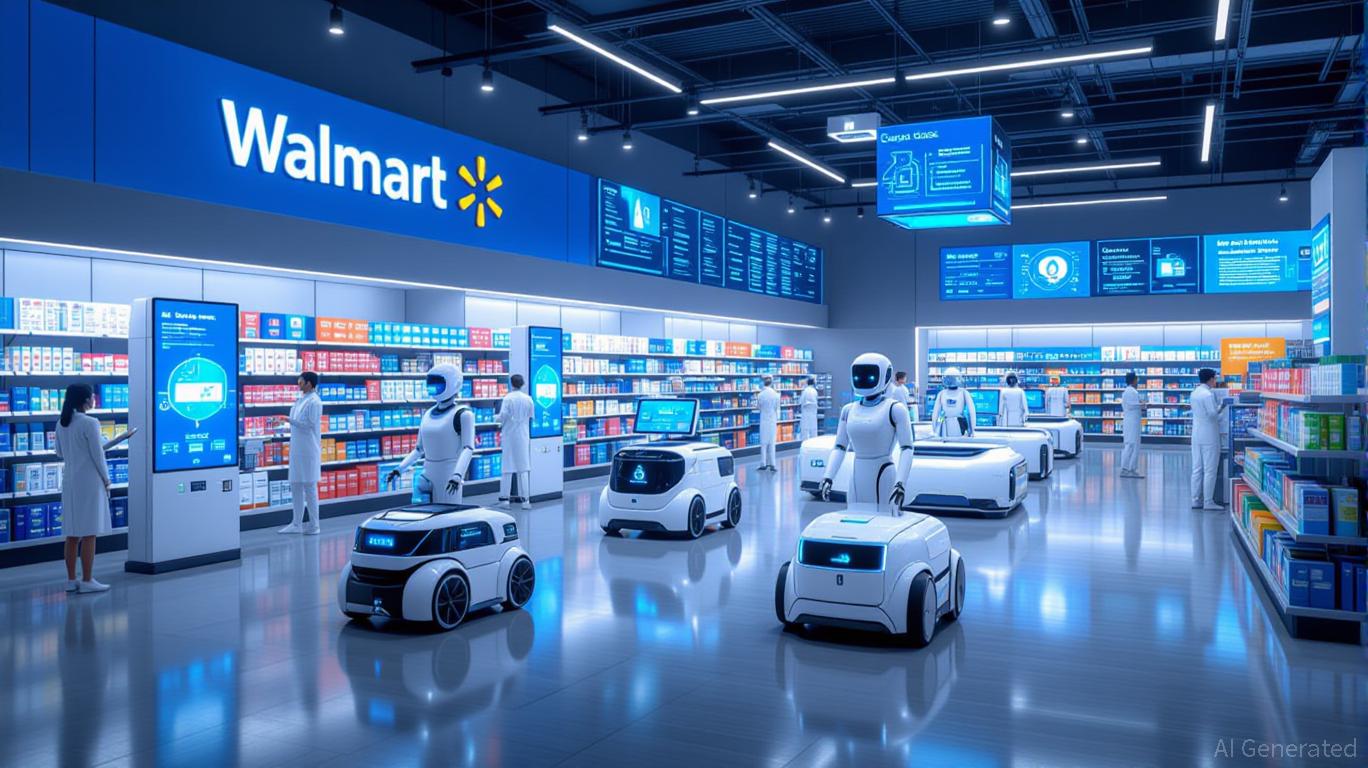

Walmart’s move to Nasdaq on December 9 was about more than symbolism. The US$905 billion retailer’s biggest claim yet: it’s no longer a traditional discount chain, but a fully tech-powered enterprise whose retail operations are being re-imagined from top to bottom by AI.
But beneath the PR hype and barrage of AI announcements, what’s really changing at the world’s largest retailer – and where do things fall short in terms of ambition versus execution?
The Agentic AI turn: Not off-the-shelf, but purpose-built
Competencia que no es del agrado de Tencent y AMD y adoptan una estrategia completamente distinta en cuanto a IA. PGA.COM If you thought that the six big language model competitors would be enough for Walmart to pounce, think again. The company is in the process of deploying what it terms “purpose-built agentic AI” – specialized tools trained on Walmart’s proprietary retail data, as opposed to a one-size-fits-all system, CTO Hari Vasudev explained.
“At Walmart, our methods to agentic AI are scalpel sharp,” Vasudev wrote in a May 2025 blog post. “Wide-ranging early testing showed us that for agents to be most effective, they should each be dedicated and optimized for targeted tasks, producing results that can then be strung together to manage and solve large workflows,” he said.
This has clear uses, according to tweag, Walmart’s “Trend-to-Product” system reduces calendar time-to-market for fashion by 18 weeks. Its GenAI Customer Support Assistant is now able to auto-dispatch and resolve inquiries without human involvement.
Developer productivity tools automate test generation and error resolution in CI/CD pipelines. The company’s retail-specific LLM, “Wallaby” (trained on decades of Walmart transaction data), provides everything from item comparisons to helping complete a personalised shopping journey.
The infrastructure underpinning this? Element: Walmart’s Open MLOps Platform Designed for No Vendor Lock-in and maximizing the usage of GPUs across various cloud providers. It’s an in-house “factory” of sorts that allows Walmart to move fast and be nimble, something competitors with lumbering third-party platforms can’t replicate.
Real numbers: Where AI has actual enterprise impact
Walmart has been uncharacteristically open about specific ROI numbers, providing a rare glimpse into enterprise AI economics:
Data operations: GenAI processed a corpus of over 850 million product catalogue data points, equivalent to “a team of 100 times the size could have used manual labor” – from the company’s CEO Doug McMillon, August 2024 earnings call.
Supply chain efficiency:
AI route optimisation saved 30 million miles of unnecessary deliveries and averted 94m lbs (42,000 tonnes) of CO2 emissions. The company has since commercialized it as a SaaS product for other companies and, in 2023, won the prestigious Franz Edelman Award for this technology.
Store operations:
Digital twin technology enables fridges and freezers to predict failures up to 2 weeks in advance, generating work orders with visual simulations, wiring diagrams, and replacement parts. Sam’s Club’s AI-based exit technology has cut member check-out times by 21% , and more than 64% of members now use the friction-free system in all locations.
The customer experience: Sophisticated delivery algorithms will dynamically calculate traffic patterns, weather, and order complexity to predict delivery time — down to the minute— resulting in forecasted 17-minute express deliveries in markets where the company has tested.
The Human Cost AI will change every job.
McMillon has not tried to sugarcoat the implications for the workforce. At a Bentonville workforce conference in September 2025, he said: “It’s very clear that AI is going to revolutionize every single job literally. Perhaps there is a job on the planet that AI will not transform, but I have not met it yet.”
But Walmart casts this as a transformation, not an elimination. McMillon sees total headcount remaining at the same level while revenue grows – that means jobs will move, not vanish. White-collar jobs are the first in the crosshairs, with chatbots handling customer service and supply-chain processing, followed by store and warehouse jobs, which will see activities absorbed by robotic processes.
The company is investing millions in retraining initiatives. “We’ve got to provide the opportunity for everyone to make it across the other side,” McMillon said at the Bentonville conference. “We used to be 85% physical. Now it’s 85% mental. I’m problem-solving with my mind, not only my body.”
The Nasdaq gambit: Reinventing for tech valuations
Walmart’s exchange transfer was pretty explicit in its framing: its AI transformation. CFO John David Rainey said its introduction immerses the company “in redefining omnichannel retail by infusing automation and AI.
The subtext? Walmart covets the valuation multiples tech companies enjoy. With a P/E multiple of 40.3x (even higher than Amazon’s and Microsoft’s), the market is probably already partially pricing in this transformative narrative. A possible addition to the tech-heavy Nasdaq 100 index would spur passive fund buying, irrespective of AI implementation.
Analysts are divided on whether the premium makes sense. Jefferies’ Corey Tarlowe said the move indicates that Walmart is “less of a traditional retail corporation and more of a technology company.” But sceptics observe that the company still earns revenue from razor-thin retail margins, not from high-margin software or cloud services – even though it has turned some of its tools (like Route Optimisation) into products.
Judgment: Real transformation with implementation risk
Walmart’s approach to AI isn’t all hype — nor is it a guaranteed success. The company is investing strategically in proprietary infrastructure, rolling out our AI at an accurate scale with documented operational benefits, and confronting workforce impacts that much of the industry prefers to avoid.
Yet there are substantial execution risks: controlling a fragmented agent universe, avoiding algorithmic bias at scale, battling external shopping agents, and determining what to automate and when (and when not) while maintaining accuracy.
The company’s honesty about the difficulties — “all too often, a co-pilot model, where an AI system works together with humans as a team, is the best approach” — indicates that leadership knows AI isn’t a panacea.
For companies out there watching Walmart’s playbook, the takeaway is to design for specificity, not generality. Invest in proprietary data moats, and think of how to transform workforces, not just reduce costs – and recognize that agentic AI is still early-stage technology with very real limitations even with vast resources and technical talent.
It’s not a matter of whether Walmart is utilizing AI – it most certainly is. It’s whether this surgical, infrastructure-heavy strategy results in sustainable competitive advantage, or if the company is automating its way into the same low-margin trap with shinier tools.
It’s too early to know for sure – but Walmart’s willingness to risk its US$905 billion market cap on the transformation suggests leadership has faith in the latter.